Proposed Design of the Digital Euro
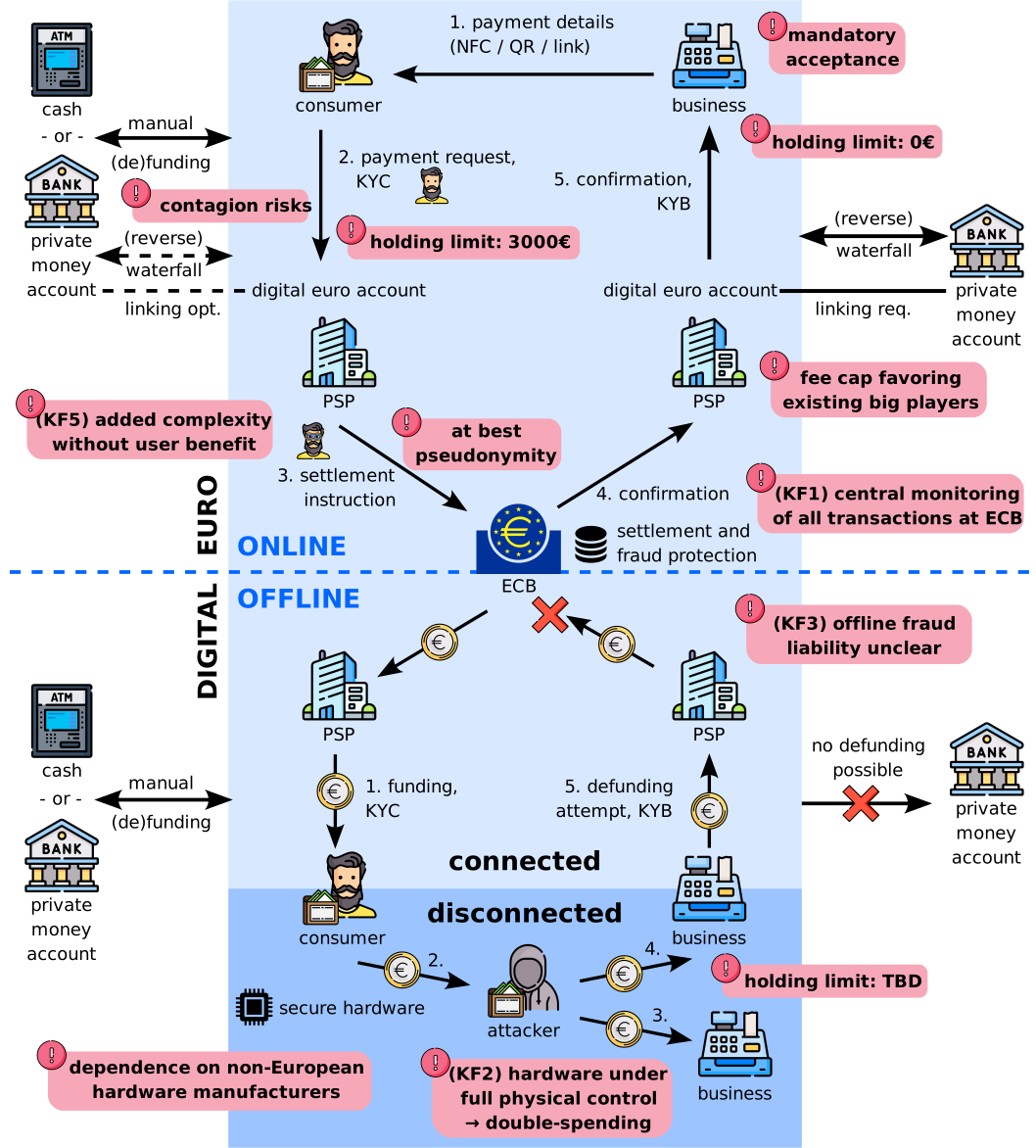
The ECB proposes “the digital euro”, suggesting a single digital version of the euro. In fact, its design encompasses two mostly separate parts as depicted in the diagram above: The online version which adds another layer of complexity to the existing digital payment infrastructure; and the offline version which is supposed to mostly resemble physical cash by providing transitive anonymity and operation with only occasional Internet connectivity. Both follow a two-tiered architecture, where the ECB acts as the central trusted instance for issuance and settlement. Participating payment service providers (PSPs) such as banks or public entities [1] interact with end-users for identification and authentication adhering to legal know-your-customer (KYC) and know-your-business (KYB) requirements. Using the digital euro is free of charge for end users, while PSPs are allowed (and expected) to charge fees up to a certain cap from merchants, who at the same time will be legally required to accept the digital euro [1].
Online version #
Users of the online version have to open a separate digital euro account (DEA) at a PSP. Different to common bank accounts, these are interest free and subject to a holding limit to ensure financial stability of the contemporary commercial bank system [2]. In order to ease user experience despite this holding limit, it is possible to link a commercial bank account to the DEA for automatic defunding in case the reception of a transaction would raise the balance above the holding limit (“waterfall”), and for automatic funding in case the amount to be paid exceeds the DEA balance (“reverse waterfall”) [3]. The holding limit for non-business users is discussed to be around €3000 [4], while business users are not allowed to hold digital euros at all (with still unclear implications for offline usage), thereby making the linking of a commercial bank account a requirement for business users [5]. All online digital euro transactions are visible to the PSP, while the transaction data for the central settlement at the ECB is at best pseudonymized [6]. To ensure the validity of digital euro transactions, the ECB maintains a central database of all DEA balances (KF1) [3].
Offline version #
The offline version [2] builds on a completely separate technical basis: a digital bearer (token) that represents a certain value, issued and validated at the ECB as a central instance. Aiming to prevent digital copies of the bearer and double-spending, the bearer is stored on a dedicated device (e.g., smartphone or smartcard) supported by so-called “secure hardware”—a separate piece of hardware for sensitive data promising protection against software and hardware attacks. Those bearers are meant to be passed transitively between users without central settlement, and to not record any trace of the transactions, thereby providing full anonymity for both payer and payee. However, Internet connectivity and identification is required for initial funding (conversion of cash or commercial bank money to digital euros) and final defunding (conversion of digital euros to cash or commercial bank money), among others to ensure the holding limit shared with the online version [3]. Fraud such as double-spending can only be detected with a delay during defunding (KF2), and the ECB leaves the question of liability in such cases open (KF3).
- European Commission, Proposal for a regulation of the european parliament and of the council on the establishment of the digital euro, 2023. [Online]. Available: https://eur-lex.europa.eu/legal-content/EN/TXT/?uri=CELEX:52023PC0369
- European Central Bank, Progress on the preparation phase of a digital euro - first progress report. https://www.ecb.europa.eu/euro/digital_euro/progress/html/ecb.deprp202406.en.html, 2024.
- European Central Bank, Update on the work of the digital euro scheme’s rulebook development group. https://www.ecb.europa.eu/euro/digital_euro/timeline/profuse/shared/pdf/ecb.degov240103_RDG_digital_euro_schemes_update.en.pdf, 2024.
- European Central Bank, Financial stability review. https://www.ecb.europa.eu/press/financial-stability-publications/fsr/html/ecb.fsr202311~bfe9d7c565.en.html, 2023.
- European Central Bank, A stocktake on the digital euro - summary report on the investigation phase and outlook on the next phase. https://www.ecb.europa.eu/euro/digital_euro/timeline/profuse/shared/pdf//ecb.dedocs231018.en.pdf, 2023.
- European Central Bank, Progress on the preparation phase of a digital euro: Closing progress report. Publications Office of the European Union, 2025. [Online]. Available: https://data.europa.eu/doi/10.2866/3423337 [Accessed: Jan. 19, 2026].